Relief & CharityFaith & Culture
Mosque Food Pantries Expand Partnerships to Meet Rising Need

From Long Island to Los Angeles, masjids are partnering with regional food banks and nonprofits to feed families
Mosque-based food pantries have become a growing fixture of community infrastructure across the country, often built through formal partnerships with regional food banks and interfaith or immigrant-services nonprofits rather than run as standalone charity efforts.
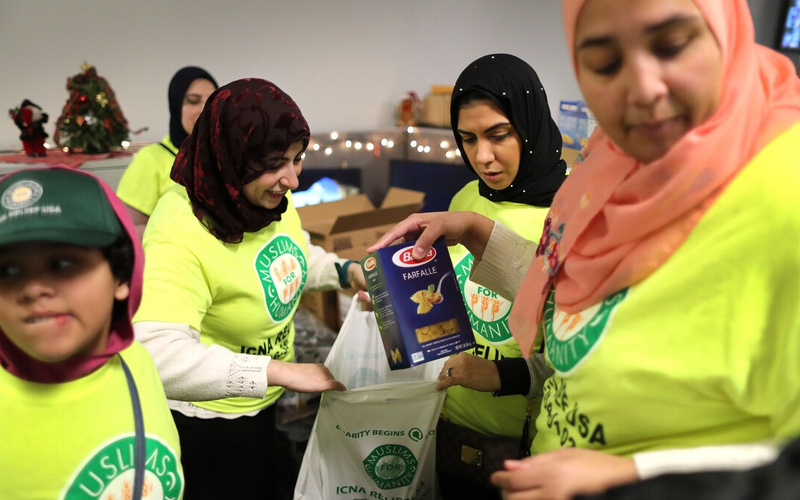
On Long Island, Masjid Hamza in Valley Stream, New York, opened a food pantry in partnership with the nonprofit Islamic Circle of North America (ICNA). Within weeks of opening, the pantry had helped feed nearly 400 families, according to ICNA outreach coordinator Shumaila Noor, who said each family receives up to 40 pounds of food weekly, with an emphasis on ethnic foods suited to the community it serves [1]. Noor said the partnership grew out of earlier collaboration between the mosque and ICNA on housing and shelter referrals, calling the pantry a way of “building a bridge” to meet needs that are often invisible from the outside [1].
Trusted Access Points Across the Country
In the Chicago area, the Mosque Foundation in Bridgeview operates a weekly pantry in partnership with the Greater Chicago Food Depository, one of the region’s largest hunger-relief organizations, distributing groceries to residents across Cook County [2]. In Round Lake, Illinois, Masjid Rahmah runs the Rahmah Interfaith Food Pantry, explicitly organized as a joint effort serving several surrounding towns [3].
On the West Coast, the Islamic Center of Southern California has run its food pantry in partnership with the LA Regional Food Bank since 2004, distributing groceries every Saturday to residents of Koreatown, one of the longer-running examples of a sustained mosque–food bank partnership in the country [4].
Some mosques frame the work explicitly in religious terms. The Muslim Community Center in Silver Spring, Maryland, describes its monthly food distributions as a direct reflection of Quranic teachings on charity, serving what it describes as “the poor, needy, and refugees” in its area through both regular and holiday-season distributions [5].
Across these programs, a common pattern emerges: mosques increasingly serve as trusted access points for families, including immigrant and refugee households, who may be more comfortable seeking help through familiar community institutions than through government assistance programs directly, even as the food itself is sourced through partnerships with larger regional food banks.
Sources
- Islamic Circle of North America, “Mosque opens first-of-its-kind food pantry” — https://icna.org/mosque-opens-first-of-its-kind-food-pantry/
- Greater Chicago Food Depository, “Mosque Foundation” partner listing — https://www.chicagosfoodbank.org/locations/mosque-foundation/
- findhelp.org, “Rahmah Interfaith Food Pantry – Masjid Rahmah Great America Islamic Center” — https://www.findhelp.org/masjid-rahmah-great-america-islamic-center–round-lake-il–rahmah-interfaith-food-pantry/6282912609665024
- Islamic Center of Southern California, “Food Pantry” — https://islamiccenter.com/food-pantry/
- Muslim Community Center (Silver Spring, MD), “Food Pantry” — https://www.mccmd.org/services/food-pantry
More on Relief & Charity
See all →
HHRD Debunks Common Winter Relief Program Misconceptions as Winter Preparations Begin
IslamiCity Spotlights Community Feeding Program in New York

Major Muslim Charity Rebrands Under Congressional Pressure
Nearly a Year Into the Gaza Ceasefire, Palestinians Are Still Waiting for the Relief They Were Promised
Related
Discover ICNA Relief USA To Support Those in Need
ICNA Relief USA assists and empowers underprivileged Americans through sustainable social services and relief programs. The organization works to build healthy communities, strengthen families, and create opportunities for those in despair while maintaining their dignity and advocating for their basic human needs. With its headquarters located in Jamaica, NY, USA, ICNA Relief operates under the…
ICNA Nonprofit Financial Transparency – Under the Leadership of CFO Altaj Ilyas
ICNA Relief and its financial transparency as a nonprofit has garnered numerous accolades for its exceptional service. The organization proudly owns a sterling 4 out of 4 stars rating from the charity platform Charity Navigator, a testament to its commitment to transparency and responsible financial stewardship. Moreover, the charity has consistently met the rigorous Standards…