Muslim American Civic Groups Ramp Up Turnout Push Ahead of 2026 Midterms
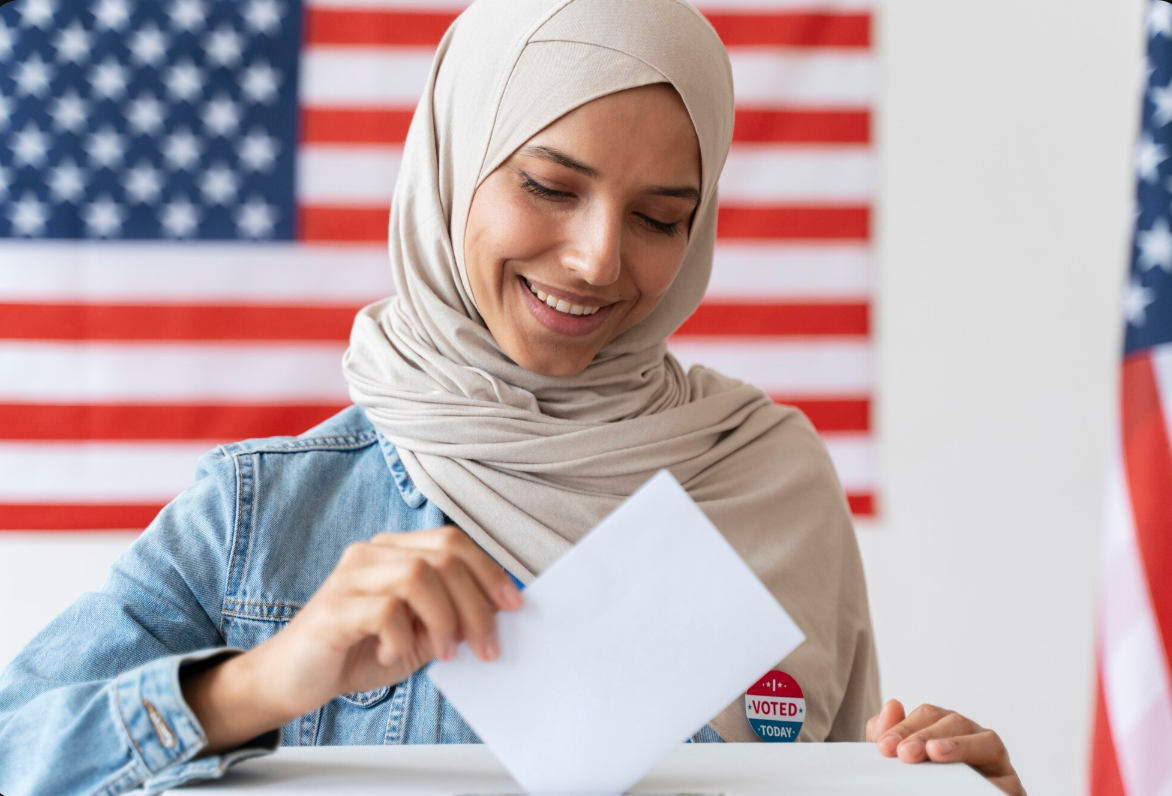
CAIR’s new Muslims Vote platform and expanding local representation aim to close a persistent voter-eligibility gap.
With the November 3, 2026 midterms approaching, Muslim American civic organizations are running one of the most coordinated voter mobilization efforts the community has seen, combining new digital tools, mosque-based outreach, and expanded local political representation.
The Council on American-Islamic Relations (CAIR), the nation’s largest Muslim civil rights and advocacy organization, launched a national platform this summer called Muslims. Vote, built as a hub where users can check their registration status, find election dates, locate polling places, and build a personalized voting plan. CAIR’s Government Affairs Department Director, Robert S. McCaw, framed the effort in religious terms, describing voting as “an amanah, a trust and responsibility” [1].
Scale, Gaps, and Growing Representation
The scale of the target audience is significant: Muslims. Vote estimates the U.S. Muslim population at roughly 8 million people, with more than 3 million registered voters, concentrated in states expected to help decide control of Congress this cycle [2, 3]. CAIR’s mobilization plan for the cycle relies on a network of more than 35 chapters, each expected to designate a civic engagement lead and file regular mobilization reports, supported by tools including a congressional scorecard and multilingual voter guides [3].
That push comes against real structural headwinds. According to the Institute for Social Policy and Understanding’s 2025 American Muslim Poll, Muslims remain the faith group least likely to be legally eligible to vote in the U.S., at 79%, compared with 90% of the general public. Eligibility varies by background, with older, white, Black, and Arab Muslims more likely to be eligible than Asian American Muslims or Muslims under 30 [4]. The same poll found that Muslims otherwise engage in civic life, such as attending town halls and contacting officials, at rates matching or exceeding those of most other groups measured [4].
Representation efforts are expanding alongside turnout work. CAIR and CAIR Action are preparing to release their 2026 Directory of Elected Muslim Officials. CAIR Action Executive Director Basim Elkarra called it evidence of the community’s growing civic footprint, while noting that 24 states still have no identified Muslim elected officials, a reminder of how much organizing work remains [5].
Newer, more targeted organizing is also emerging. The Black Muslim Leadership Council, a nonprofit founded in Philadelphia in 2024 by activist Salima Suswell, focuses specifically on policy advocacy, voter turnout, and leadership development within Black American Muslim communities, reflecting efforts to address the community’s internal diversity rather than treat Muslim voters as a single bloc [6].
Sources
- CAIR, “Community Advisory: CAIR Launches Muslims. Vote to Empower American Muslim Voters Ahead of the 2026 Midterm Election,” cair.com, July 30, 2026 — https://www.cair.com/press_releases/community-advisory-cair-launches-muslims-vote-to-empower-american-muslim-voters-ahead-of-the-2026-midterm-election-upcoming-michigan-primary-august-4th/
- Muslims.Vote — https://muslims.vote/
- CAIR/CAIR Action, “The 2026 Strategic Election Plan” — https://muslims.vote/strategic-election-plan/
- Institute for Social Policy and Understanding, “American Muslim Poll 2025: Spotlight on Muslim Voters” — https://ispu.org/poll/american-muslim-poll-2025-full-report-3/
- CAIR, “CAIR, CAIR Action to Release 2026 Directory of Elected Muslim Officials” — https://www.cair.com/press_releases/cair-cair-action-to-release-2026-directory-of-elected-muslim-officials-documenting-muslim-civic-leadership-across-america/
- Wikipedia, “Black Muslim Leadership Council” — https://en.wikipedia.org/wiki/Black_Muslim_Leadership_Council
More on Politics & Policy
See all →

Related
Texas Schools Approve Curriculum Muslim Students Call an Attack on Their Faith
Fifteen-year-old Habiiba Quresh stood before the Texas State Board of Education and said what thousands of Muslim families across the state were feeling: that a single sentence written by adults who don’t share her faith had made her feel like she didn’t belong in her own history class. Days later, on September 5, the…